What Fire Brand do you want in your home?

Followers

Recent Updates

Celsi Fires Now in the UK

Celsi fires have now been released in the UK, with great reviews all over, the new technology is virtually a computer pretening to be a fire, with clean looks and great prices they are bound to be a hit.More…


Showing posts with label woodburning stove. Show all posts

Friday, 18 November 2011

Do I Need A Flue Liner?

If you have a standard masonry chimney and wish to install a woodburning or multifuel stove, it is highly advisable to fit a stainless steel flexible flue liner with the stove.

Corinium Flue Systems recommends fitting a flue liner for the following reasons;

  • Masonry chimneys, particularly in older properties, are likely to have cracks. Without a liner, any fumes from the stove and creosote formed will leak through cracks in the masonry, possibly exiting in other rooms in your house or in your neighbours'.
  • Creosote is a tar like substance that is formed when fumes emitted from the stove cool down as they rise. When these gaseous fumes cool down, any substances contained within the fumes condense and are deposited on the inside of the flue or chimney. A flue liner has a smooth inner skin with less surface area for creosote to be deposited onto, whereas in a masonry chimney it is likely to build up in cracks or crevices. Creosote is highly flammable and is often the cause of chimney fires.
  • A flue liner is much narrower than a chimney and is the same diameter from top to bottom. This continuous, consistent pathway will allow the flue gases to exit the chimney much quicker, with less chance of deposits. A flue liner's narrow, consistent diameter also means that it will warm up much quicker than a chimney. This results in an improved draw, making it easier to get a fire burning without lots of smoke back into the stove. A flue liner will retain the heat longer than a chimney after the fire has died out, which means it will be easier to start a new fire the morning after the night before.
  • A flue liner is generally more straightforward to sweep. Creosote deposits formed will be harder to remove from a large chimney, especially build ups in cracks or crevices.
A question frequently asked is whether the flue should be insulated - this is done by backfilling the chimney around the flue liner. This is not necessary, but can be beneficial if you have a particularly cold chimney i.e. external, very exposed and very large. Normally the warming of the air in the chimney surrounding the liner during burning is sufficient for insulation.

They are also frequently asked whether a flue liner is necessary to comply with building regulations. It does not state in the building regulations that a flue liner has to be fitted with a stove. However, you must be sure that the chimney is in good working condition and has been sufficiently maintained. The majority of installers and retailers will recommend fitting a flue liner; particularly in older properties, as it is safer and more efficient.

We do not advise asking your installer not to fit a flue liner purely on the basis of cost. Once you have made the one off investment, your stove and flue liner, if properly maintained, will last for years. Most stove and flue manufacturers offer a warranty on their products - for example, Corinium offer a ten year warranty on our flue liner, subject to conditions of use.

Monday, 14 November 2011

We love our wood-burning stove in the house we’ve just bought, but...

We love our wood-burning stove in the house we’ve just bought, but I have discovered we live in a smoke control area. 

This is the question faced by dozens, if not hundreds of individuals, couples and families faced every year as they purchase their new house, complete with stove, envisioning the stereo-typically romantic image of sat around the stove, the warm glow eminating from the window and bathing everyone in the warm glow. Putting an extra log on the stove as the fire every so often, just to top up the heat.

However this dream can quickly become a nightmare if you become informed you live in a smokeless zone and your stove is not DEFRA approved.
However not all is lost, you can still keep your stove, however you would be slightly restricted to burning smokeless fuels, DEFRA approved status merely means that the stove has been given approval by DEFRA to be exempt from the clean air act when burning wood.

So not to worry if you've just bought a house with a stove that isn't DEFRA approved, you can still burn smokeless fuels and enjoy that romantic image of relaxing in front of a blazing stove with the room covered in the warm glow.


Saturday, 22 October 2011

Wood Burners Could Be The Answer To Heating Your Home This Winter


The ever-rising cost of gas, oil and electricity has fired the imagination of householders trying to save on their heating bills. It’s not only good news for environment, it’s also providing a growing business for people involved in forestry and those selling wood and log-burning stoves.

The experience of George Newburn, who runs Lytham Logs on the Fylde, is typical. He supplies high quality natural hardwood and softwood from sustainable plantations in Cumbria.

‘It’s amazing how many people are contacting me because they’ve had a wood-burning stove installed that day,’ he says. ‘I ran out of wood in the middle of January last year so I’ve now got 300 cubic metres of logs in stock.’

That’s a lot when you consider a normal sized rubbish skip hold just five cubic metres. ‘Wood is carbon neutral and people are starting to accept the environmental arguments,’ he adds. ‘People are using more wood and less coal, which has to be shipped from places like Poland.’

George does have some words of caution, however. ‘If we keep burning hardwood at the current rate we will run out one day. Softwood is cheaper and quicker to grown. In fact, it grows twice as quickly but it doesn’t burn twice as fast.

‘People with open fires don’t like it because it has a higher resin content and that causes it to spit. But it’s fine for wood-burners and we need to start educating people about the difference.’

John Stanley launched Vesta Stoves in Scarisbrick five years ago. ‘We are probably one of the only companies in the country that actually makes wood-burners rather than importing them,’ he says.

‘Wood-burners are increasing in popularity all the time and they do have lots of advantages. With gas prices going up and up, they are seen as a real investment and they are much more efficient and controllable than an open fire where about 80 per cent of the heat goes up the chimney.

‘If you burn £200 a year on an open fire, that would come down to about £50 a year with a wood-burner. The payback is almost instant.

‘Wood-burners with boilers are becoming massively more popular now as well. They are a big investment – you need a different kind of water tank for one thing – and the payback time is nearer ten years but they can reduce fuel bills dramatically.’

Nick Astley, who runs Fuelmizas, retailing a wide range of wood-burners in Ribchester, believes the economic argument is the main driver. ‘The powers that be would like to think people are buying wood-burners because they are carbon neutral and envionmentally-friendly but it’s really the price of fuel that’s causing the change.

‘Some are put off because they have concerns about living in restricted areas but you can now get Defra-approved wood-burners for smoke-free zones.

‘Others have visions of having to go out to collect wood, chop it with an axe, stack it and season the logs. But life’s too short. Like most people, we simply have the wood delivered.’ Cue George.

An impressive range of wood and multifuel stoves are available from Stove Megastore, as well as a heat powered stove fan that can help distribute heat around the room, further reducing the amount of fuel needed.

Tuesday, 18 October 2011

Manufacturer Focus: Firebelly Stoves

It's now 8 years since Firebelly Woodstoves started making it's mark on the industry with the launch of the FB1, a cleverly designed stove, which is commonly viewed as a successful marriage of both modern and traditional styles.
Featuring tubular corners to offset and otherwise squarish design, the FB1 has an output of up to 6kW and the option for a rear or top 125mm (5 inch in old money) flue outlet. Measuring 522mm (width) x 605 (height) x 422mm (deep), the FB1 is also available as a double-sided "see-through" stove.
Keep It Simple
Using the same basic design, the FB2 is the FB1's bigger brother and has an output of up to 12kW and a 150mm (6inch) top or rear flue outlet. The FB2 is wider at 640mm but otherwise shares the same height and depth as the FB1. A "double-sided" is also available.
Key to the high efficiency of the FB range is the extensive use of high grade reflective ceramic linings which Firebelly have developed specifically for its designs.
More recently Firebelly has unveiled the FB1 & FB2 stoves with brushed stainless steel 'legs' which, in combination with no less than 18 Different Colours can produce some fantastic looking stoves and means that from just 2 different stoves you can have 76 Different variations, meaning you can really make your own stove unique. All from two relatively simple designs.

Log boxes and multi-fuel kits are also available together with a hot water boiler for the FB2 which can provide up to 8kW for central heating and domestic hot water.
More recent additions to the range include the FB, a small stove with an output of upto 4kW, the Firepod, a pedestal stove with an output of up to 10kW and the Razen Cookstove made from stainless steel.
"The success of Firebelly Woodstoves has a lot to do with keep the product range relatively simple but, most of all, by providing high levels of customer service." Says Craig Mollet, Managing Director of Firebelly Woodstoves.
"Our success has mostly come from innovative design and high quality manufacturing, the latter supported by substantial investment in the very latest cutting equipment which provides exception precision."

Proud To Be Built In Britain
Firebelly Woodstoves makes great play of it's product being British made and is now exporing the products all over the world, including far-afield countries such as New Zealand and Japan. Craig concludeds "The stove market in the UK is becoming ever more competitive but our determination to keep the customer satisfied has worked to our advantage and we forsee Firebelly Woodstoves to become increasingly popular for some time to come"

Saturday, 1 October 2011

Get The Maximum Heat From Your Stove

The heat energy generated by wood fuel is measured as calorific value, and the main things that effect this are wood type and moisture content.

Softwood or Hardwood?
Traditionally hardwoods - Oak, Sycamore, Ash - have been considered better as fuel than softwoods - Larch, Spruce, Douglas Fir. The reason is that hardwood is denser, so an identically sized hardwood log contains more carbon, provides more heat and burns longer.

The truth is that both are good fuels. A kilogram of softwood can have the same calorific value as a kilogram of hardwood. You will need a greater volume of softwood logs to get the same energy, because they have a lower density, but they are generally cheaper. If you have room to store more logs and you don't mind re-filling your stove a little more often then softwood could be for you.

Wet Or Dry?
The most important measure for quality of wood fuel is moisture content. A heavier log will nor necessarily give more heat as half the weight of a green stove can be water!

Wood needs to be dried, or seasoned, before burning. Forced or accelerated drying in powered or solar kilns is becoming more common with wood fuel processors.
The more water in the wood you burn, the less heat for your house, because some of the hear released from your fire will have to evaporate the water, cooling the whole burning process down. This is heat that should be used to heat your home rather than create I efficient steam.
Burning wet wood with more than 25% moisture content creates corrosive smoke and tar that can damage flue linings and cause chimney fires. Dry wood produces little smoke, low tar deposits and high efficiency heat output, especially when burnt in a modern appliance able to efficiently burn combustion gases.

Freshly harvested wood will typically have a moisture content of 50%. Drying wood down to 20-25% moisture content will approximately double it's heat output.
The industry quality standard has been set at 25% moisture content or less. It's always recommend you buy a moisture meter to test your firewood along a freshly split surface.

As-well as ensuring that you're burning the correct wood, excellent air circulation around the stove is essential to ensure the whole room is heated rather than just a hot area around the stove. Many of you may have already experienced this, the area around the stove is lovely and warm, but when you move away from the immediate vicinity of the stove the temperature drops dramatically.

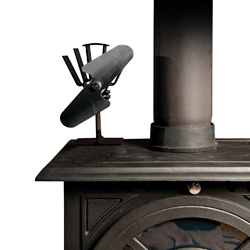
This problem can be solved by using a heat-powered stove fan, as the stove heats up the fan blades start to spin and circulate the air around the room, meaning you could essentially get more heat from your stove.

Monday, 19 September 2011

How Not To Install A Wood Burning Stove


Just a quick video to show the difference it can make using experienced, recommended fitters to install your wood burning stove.

The client had seen the work we had carried out in their next door neighbours house and wanted the same in theirs. They had their builder carry out the work to the fireplace and were going to give us a call regarding installation of the stove. They had other workmen in the house at the time who said they could arrange for the stove to be fitted as they had a friend who fitted them. The client assumed that all fitters would install his appliance to the same standard but soon found this not to be the case.

We were called out to tidy up the installation as the client was not happy with how it had been left........we did this and it was a good job he called us in as the register plate had been made from flammable material and also the stainless flexi liner was installed upside down.....this doesn't sound like a big deal bit it will take your liners life expectancy from 20 years down to a possible 5 due to condensation getting between the two skins causing the liner to corrode prematurely.

In the end the client was delighted but unfortunately had to pay for the installation twice. He had no comeback on the installer as he was a friend of a friend and didn't want to cause upset.............the installer also wasn't HETAS Registered so there was no paperwork or notification given to building control. This would be mostly likely to render his home insurance invalid should he have had a fire caused by the stove.